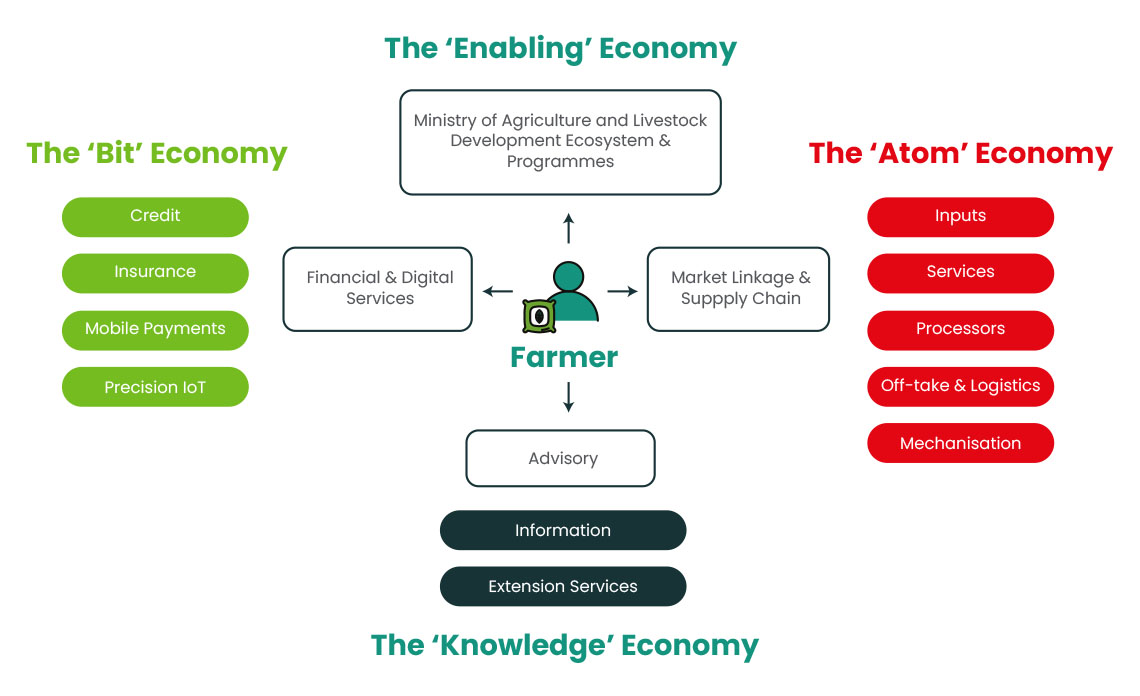
Smallholder farmers are Individuals who grow crops or farm livestock for profit usually with farms that are less than 10 hectares. Subsistence farmers grow food for their own consumption.
An agreement in which a borrower receives something of value now and agrees to repay the lender at a later date—generally with interest. Allowing the smallholder farmer to use credit as working capital to plant crops with the correct seed and agricultural inputs to secure a better outcome.
Financial protection for smallholder farmers against crop failures or underperforming crops due to drought.
Allows smallholder farmers, even those without bank accounts, to transfer money, pay bills, and trade using basic mobile phones. Allowing smallholder farmers to transact with all stakeholders to build their agricultural enterprise.
The Internet of Things (IoT) is helping change the way that farmers work through improved knowledge. Precision farming is a way of farm management that uses sensors, data, and network communication to tailor the farming system to the specific conditions of each field.
Digitally-enabled solutions that link smallholder farmers to high-quality farm inputs (e.g., seeds, fertilisers, herbicides/pesticides), to production and post-harvest machinery and mechanisation services (e.g. irrigation, tractors, cold storage), or to off-take markets, including agro-dealers, wholesalers, retailers, or even to the end-consumer.
Digital supply chain management solutions are business-to-business services that help agribusinesses, cooperatives, nucleus farms, input agro-dealers, and other smallholder farmer value chain intermediaries to manage their smallholder relationships. (CTA D4Ag Digitalisation report, 2019).
Businesses buying crops and produce from smallholder farmers.
Companies selling farming inputs such as seed, fertiliser, and herbicides or pesticides as well as machinery such as tractors or irrigation.
Processors are entities that add value to the agricultural produce. This could include milling and oil extraction all the way though to cleaning and packaging.
Formal or informal “buyers” or collection entities / entrepreneurs. Aggregators buy from farmers at a low price and then resell to offtakers at a margin. Can have a long standing relationship with a specific off taker in their region. Mostly independent and not employed by large off takers.
Many smallholder farmers do not have access to transport services and these services need to be contracted to arrange for the transportation of crops to off takers.
Digital solutions that extend farmer access to agricultural machinery or mechanised farm services (e.g. irrigation, tractors, cold storage).
We provide agricultural content to the farmers including weather updates and agricultural tips and best practices.
An agricultural extension service offers technical advice on agriculture to farmers, and also supplies them with the necessary inputs and services to support their agricultural production.
The net effect is that at a farmer level, productivity, yields and income can increase by 70-80%; farmers, through appropriate training, learning and support can become more resilient and climate smarter in the face of significant and worsening environmental pressures.
In addition, through focused interventions (e.g. Female extension officers, women focused financial products), gender and equity redress becomes more achievable. Participating enterprises benefit from access to new markets, enhanced security of supply, improved consistency in quality and traceability (compliance) of produce and the ability to securely and quickly transact with farmers. Overall, food security is enhanced, livelihoods significantly improved and societies become more productive and settled.